Old King Henry had six wives Whose days were full of dread For most of them led tragic lives Then often wound up dead. Catherine of Aragon To whom he first proposed Could not produce a princely son So he said Adios! Then Anne Boleyn, closer to home Demanded that they wed So Henry cut off ties with Rome And then cut off her head. Poor Jane Seymour was the one Who finally played her part When she, at last, produced a son But died, which broke his heart. Anne of Cleves, the next one booked Was regal, young and wealthy The problem was she didn’t look Quite like her royal selfie. Catherine Howard, it was said No man had ever dated But rumours spread after they’d wed So was decapitated. Catherine Parr, a lively sort Who wielded her own power Helped organise his kids and court Once she’d escaped The Tower.
All Henry wanted was a son A prince whom he could teach To rule his people when he’d gone But this was out of reach. The irony which overwhelms This patriarchal scene? He gave to England and its realms Perhaps their greatest queen Because Young Bess, put to the test Excelled in her employ And showed the world it takes a girl To do it like a boy.
The figure on the mountain knew Far higher than the eagle flew Beyond the sun and past the light Were men who crossed the sky by night. Soon after dusk their fires appeared Then slowly, once a course was steered Their caravan set out en masse To make its empyreal pass.
Like beasts migrating on the plains Like swarms that form to greet the rains He found no word for the amount Of travelers he sought to count. A gallery would pass him by Whose outlines seemed to signify Proud emblems of a noble clan Led by an even a greater man.
The bearing, always east to west Suggested they were on a quest Or maybe searching for a door They’d passed through in a time before. Each night the figure danced and prayed Around the fire he had made In hope his kin might see its glow And teach him all he wished to know.
Then with the last beat from his breast Great Spirit granted this request And drew his outline in the sky That men as he should never die
Beware the Ides! foretells the fall Of he who rose to conquer Gaul And lands still further from his home This warrior, this son of Rome. On his return to claim his right A haruspex with second sight Met Caesar by the Senate arch To warn him of the Ides of March. They’d killed an ox and found no spleen An omen that could only mean The Consul should fear for his life As did, Calpurnia, his wife. But Caesar didn’t fear the gods For he had overcome the odds To overshadow mortal men And take his seat in Rome again. So came the day, but nothing passed Until the Senators amassed Fulfilling what was prophesied Thus, on the fifteenth, Caesar died. Of every haruspex, it’s said They earn their living from the dead And though they claim the role of seer It’s often what we overhear
“That’s what they want you to think,” Laverne lowered her voice. “Look around… what do you see?”
“Happy fat people.”
“All of them?”
“All the ones eating pizza,” I was able to confirm.
“What about him on his own over at the salad bar? What’s his story?”
“That’s a woman.”
“Okay, whatever, but ask yourself this: what type of person comes to Pizza Hut to load up on celery?”
“Maybe she’s the nurse.”
“Restaurants don’t have nurses.”
“This one should.”
“John, what am I always telling you?”
“It’s only a phase?”
“That was your mother.”
“Never make eye contact while eating a banana?”
“That was your cellmate.”
“If someone’s crying don’t ask them if it’s because of their haircut?”
“There are two types of people in this world: those who like pizza and-”
“-nurses?”
“Communists.”
“You’re why aliens don’t talk to us.”
“The Macarena is why aliens don’t talk to us,” Laverne sniffed. “Anyway, I need to talk to you about something else.”
“Shoot.”
“How can I get myself into The Bible?”
“Oh my God…”
“Is that what I should do? Should I pray?”
“That wasn’t praying.”
“Then you, my friend, have just blasphemed,” Laverne waved a menacing finger in my direction.
“Since when have you been religious?”
“Pam’s published an eBook.”
“And…”
“It’s a collection of poems which are just dreadful.”
“So…”
“I think one’s about me.”
“Because…”
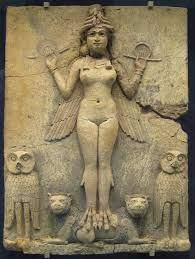
“It tells the story of a beautiful Mesopotamian goddess.”
“You’re from Wisconsin.”
“Maybe it wasn’t always called that.”
“So, you’re thinking that if you’re a goddess you should be in the same book as God.”
“I should at least be on the sleeve,” Laverne reasoned.
“Right, here comes the waitress so would you please come out from under the table?”
“Are you ready to order?” the young woman asked.
“Have all of these animals on the menu been freshly killed?” Laverne enquired, emerging to take her seat.
“Please excuse my friend, she’s Mesopotamian,” I interjected.
“Uh huh…” our waitress needed more.
“She was just looking for somewhere to bury any leftovers.”
“You’re not really allowed to do that,” she advised us.
“Then I’ll just have the buffet special,” Laverne set down her menu.
“Anything to drink?”
“I’ve just topped up my gourd so that won’t be necessary, thank you.”
“I’ll have the Buffet Special and a Coke,” I jumped in again.
The waitress stared at her pad, unsure of what to write.
“Two Buffets Specials and one Coke.”
“Right,” she sighed with relief. “You confused me there for a minute.”
“I apologise,” Laverne continued, “it’s just that all of this takes me back.”
“All of what?” the waitress asked.
“These ancient murals. That one, for example, is it Babylonian?”
“That’s Cher at The Oscars.”
“So it’s not a mummy then?”
“I can check, if you’d like.”
“Would you?”
“I’ll be right back with your drink so please help yourself to the buffet,” the girl managed to get out, before backing into another table on her way to the kitchen.
“Mesopotamia?” Laverne laughed.
“From a mud hut to Pizza Hut within the blink of an evil eye.”
“We’ve got her on the run,” Laverne smirked. “I love waitresses.”
“Excuse me, but did you find your earring?” a dashing maître d’ approached our table.
“How did you know that’s what I was looking for?” Laverne asked, delighted.
“It’s my job to notice everything. For example, I also noticed that you didn’t order a drink. May I get you one now?”
“A gin and tonic would be lovely,” came the order.
“When I return, I’ll help you look for your earring,” he promised, before dashing off.
“Dark and swarthy with an accent. Good thing he wasn’t selling sand because you’d have ordered it as a starter.”
“You know us Valley Girls,” Laverne sighed, “we just can’t resist a man in cuneiform.”
The new teacher entered the classroom and took her seat, greeting no one. Perpetua Tightwaters was having a bad day but her deportment made it impossible for the students to tell because she held only one expression in her armoury: disapproval. A fierce-looking woman with grey-blue eyes which devoured their prey whole, she could scan an entire school assembly at a glance over horn-rimmed glasses designed to gore enemies at close range. Thick, silvery hair which still held its lustre was meticulously hoovered up into a tidy bun, giving her the air of a grande dame of the Bolshoi who had long since exited the stage, but not the company. A smooth complexion required only a light touch from a modest palate; it was only her mauve lipstick which strayed into the adventurous, considered redundant by many because her lips were permanently pursed until they parted to issue a summons, reprimand or decree.
Perpetua Tightwaters loved crosswords, hated skateboarders, still bought her meat from the local butcher, donated to the Red Cross by direct debit, considered pet ownership overrated, knew her brother-in-law had a drinking problem before he did and stopped listening to Engelbert Humperdinck the day the singer made a joke about the Queen Mother during a live interview on Radio 4.
Alert and self-assured, she made few demands of others and expected the same courtesy in return, preferring discretion at all costs. During her morning commute into the city, Perpetua remained vigilant lest she should drop her guard for even a moment and, in doing so, make eye contact with a fellow commuter just bursting to talk about his gifted toddler’s progress at Junior Montessori. She had nothing against the public, she simply regarded them much as she did junior royals: odd-jobbers whose pivotal role might one day involve organ donation. In an increasingly unrecognisable world where meat was murder, Drag Queen Storytime had replaced Show & Tell and a pope had wavered ever so slightly on the question of married clergy, Perpetua Tightwaters chose to anchor herself in work, God and country for everyone’s sake.
In her opinion, social distancing wasn’t overkill.